
Dashi & Stock Basics: The Combinations We Actually Use Most
The broth breaks first
Same doenjang stew, yet one kitchen's version tastes deep and another's tastes flat. Is it the bean-paste brand? A magic touch? Most of the time the difference is decided one layer down, in the broth base. In Korean home cooking, the vast majority of soups, stews, hot pots, and noodle dishes are built on a single pot of stock simmered at the start. No matter how well you prep the rest, if the base is close to plain water, every flavor stacked on top of it turns thin.
The point isn't seasoning, it's umami. Salt only adds saltiness, but a well-built stock lays down the savory base that makes the tongue register "deep" and "rounded." So before "which anchovy should I buy," there's an earlier question: what do you steep, and what do you steep it with?
This piece answers that with data. First we look at which combinations the recipes in UnoRecipe actually use most, then we explain — with verified science — why those combinations beat any single ingredient.
The conclusion first: combinations almost always beat single ingredients. Anchovy (inosinate) plus kelp (glutamate) produces far more savoriness than the sum of using each alone. This isn't a matter of taste preference — it's a phenomenon that has been measured since the 1960s.
What 1,630 UnoRecipe recipes actually use for broth
Instead of guessing, we queried the corpus. Tallying the ingredient lists of the 1,630 recipes in the UnoRecipe database (every one carries an ingredient list), the Korean broth picture is dominated by aromatics, not by dedicated stock ingredients.
- Green onion 700 · onion 637 — the two most frequent, but both are general aromatics that go into almost everything, not broth-specific items. Fittingly, the single most common co-occurring pair was also green onion + onion (369 recipes).
Narrow to the ingredients that genuinely *define* a broth and the numbers thin out — and a trap appears.
- Anchovy reads as 232 by raw match, but a name-by-name audit shows most of that is processed seasoning — anchovy fish sauce (130) and anchovy MSG seasoning (29). Recipes that use whole/dried anchovy to actually make stock number only 81. "Anchovy is common" and "anchovy is used to make broth" are not the same fact.
- Radish (broth-relevant): 176 — already excluding false positives like unsalted butter, dried-radish strips, and figs, which share the Korean syllable.
- Kelp (dasima) 68 · shiitake 46 — these are the true workhorses of Korean stock.
- Bonito flakes (katsuobushi): just 3 — Japanese-style bonito dashi is barely represented in this Korean-leaning corpus.
As combinations, the canon of Korean dashi falls right out:
- Anchovy + kelp (the canonical Korean dashi base) — 36 recipes (26 when restricted to whole anchovy).
- Anchovy + kelp + radish (the classic three-item myeolchi-stock set) — 15 recipes (12 with whole anchovy).
- Anchovy + green onion + onion (the top anchovy-inclusive triple) — 66 recipes.
- Onion + shiitake (a vegetarian/vegetable-stock combo) — 30 recipes.
One honest caveat: this corpus is Korean-leaning, so bonito-based Japanese dashi is barely present (3 recipes). This article's data is therefore strong on anchovy/radish/kelp/aromatic combinations but shallow on Japanese katsuo dashi. The standard Korean home broth the data describes is clear — anchovy, kelp, radish, plus green onion and onion.
Why combinations beat singles — umami synergy
There's a reason the numbers point where they do. A broth simmered from anchovy *and* kelp runs deeper than either alone not because of a magic touch but because of chemistry — specifically umami synergy.
Three substances carry umami: glutamate (an amino acid), plus the nucleotides inosinate and guanylate. According to the Umami Information Center, the umami of glutamate is dramatically enhanced when inosinate or guanylate is present. Umami is most powerful at a glutamate-to-inosinate ratio of exactly 1:1, where the intensity is 7 to 8 times that of either compound tasted alone.
This is a measured effect, not a slogan. The synergy was first measured and discovered by Kuninaka in the 1960s, and Kenzo Kurihara's review, *Umami the Fifth Basic Taste* (BioMed Research International, 2015), likewise reports that in humans the response to a glutamate + 5'-inosinate mixture is about 8 times larger than to glutamate alone.
Translated into ingredients, the answer is simple: put a glutamate source together with an inosinate (or guanylate) source.
- Kelp is rich in glutamate — the Umami Information Center's kelp page states "dried kombu is abundant in the umami substance glutamate."
- Anchovy and bonito are rich in inosinate — the katsuobushi page says "katsuobushi contains extremely high levels of the umami substance inosinate," and that "the umami taste of dashi is greatly enhanced when the glutamate found in kombu meets the inosinate of katsuobushi." Dried anchovy sits in the same inosinate family.
- Dried shiitake supplies guanylate — pair it with kelp (glutamate) for a vegetable-stock base and the same synergy fires.
This is why Korean anchovy-and-kelp dashi rests on exactly the same principle as Japanese kelp-and-bonito dashi. My Korean Kitchen's Korean-dashi guide keeps anchovy and kelp as the core and adds radish, dried shiitake, and green-onion roots as "for a more complex and layered flavor" options — which maps precisely onto the corpus picture of anchovy 81, kelp 68, radish 176, shiitake 46.
The principle isn't one culture's secret. The Center's practical guide stresses that pairing glutamate-rich vegetables with inosinate-rich fish or meat is shared cooking wisdom worldwide — Japanese dashi, Western bouillon, and Chinese tang stocks all rely on it. Radish isn't a glutamate/inosinate powerhouse, but its sweetness and clean finish round off saltiness and off-notes — which is exactly why adding radish to "anchovy + kelp" became the standard Korean three-piece stock.
How to start your home broth
Keep it simple. The path our recipes use most is also the most validated.
- Basic Korean broth — whole anchovy (heads and entrails removed) + kelp. Soak the kelp in cold water for 30 minutes, add anchovy and bring to a boil, then pull the kelp out first (to avoid sliminess and bitterness) and simmer the anchovy 10–15 minutes more. Adding radish brings sweetness and a clean finish.
- Steep the kelp, don't boil it — glutamate extracts well, but prolonged boiling drags out mucilage and bitterness.
- For vegetarian/vegan stock — combine kelp + dried shiitake (guanylate) to harness the synergy, and add onion and radish for sweetness.
- Anchovy fish sauce and dashida are not "stock" — both are umami seasonings, distinct from the clear depth of a stock drawn from whole anchovy. Separate the job of seasoning from the job of building a base.
One line carries it all: a great broth comes not from expensive ingredients but from the right pairing. The comparison below lays out anchovy dashi, kelp, bonito, and vegetable stock by flavor, use, and steeping time at a glance.
References
The umami-synergy explanation in this article is grounded in the Umami Information Center and a peer-reviewed academic review. The full source list is in the sidebar references.
Four broth bases compared — ingredient, umami compound, flavor, use, steep time
Anchovy dashi
Whole anchovy (+kelp)
Inosinate (+glutamate)
Toasty, deep, briny, full-bodied
Doenjang/kimchi stew, noodles, kalguksu
Cold soak, then 10–15 min simmer
Kelp stock
Kelp (dashima)
Glutamate
Clear, clean umami with gentle sweetness
Clear soups, porridge, boosting other bases
30 min cold steep (do not boil)
Bonito dashi
Kelp + bonito flakes
Glutamate + inosinate
Smoky, brisk umami (Japanese dashi)
Udon, soba, miso soup (rare here — only 3 recipes)
Add bonito off-boil, 1–2 min
Vegetable stock
Kelp + shiitake (+radish/onion)
Glutamate + guanylate
Mellow, lightly sweet, plant-based umami
Vegetarian broths, clear soups, hot pots
Cold soak, then 20–30 min low simmer
Related Recipes
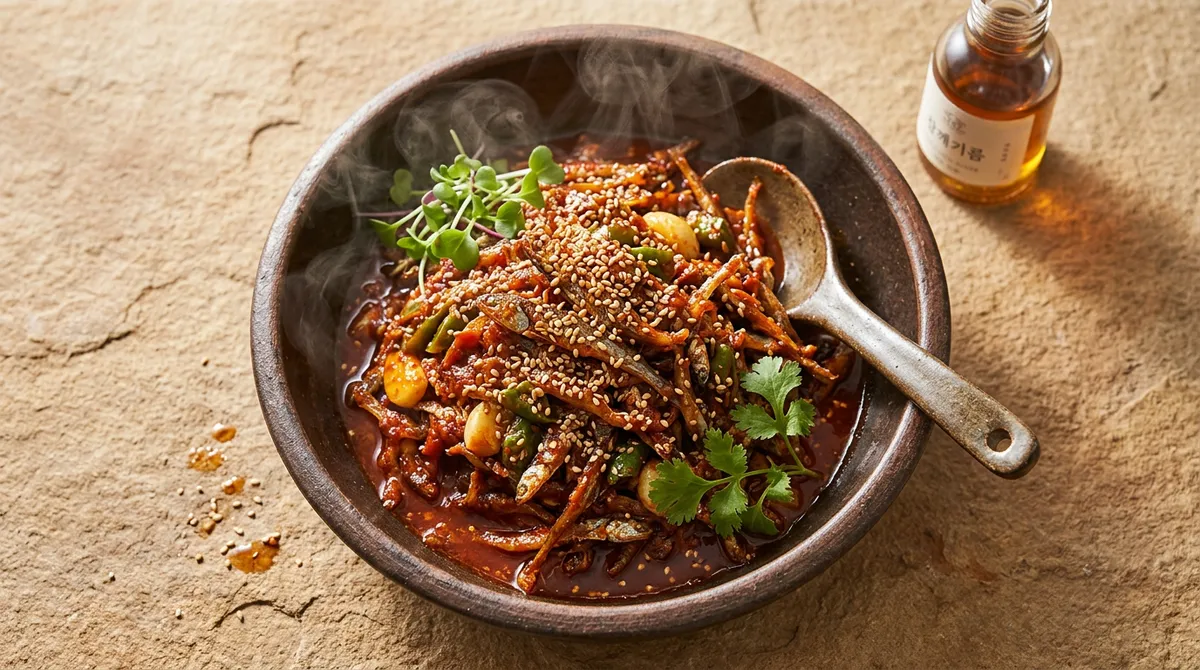 15 min
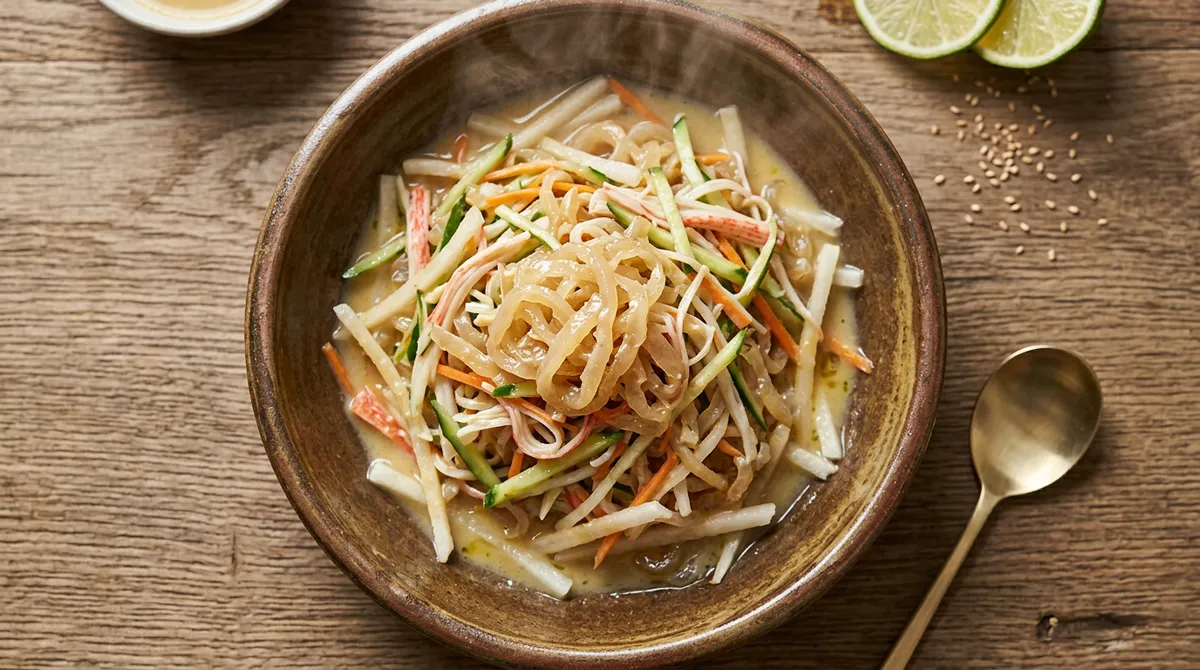 30 min
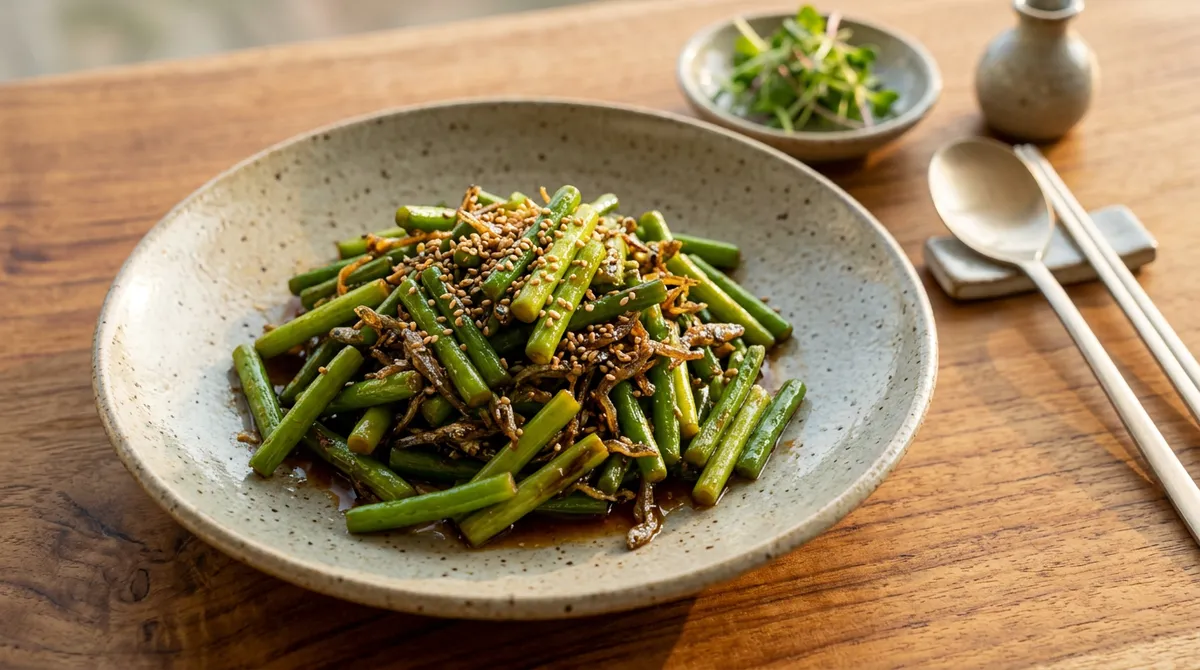 20 min
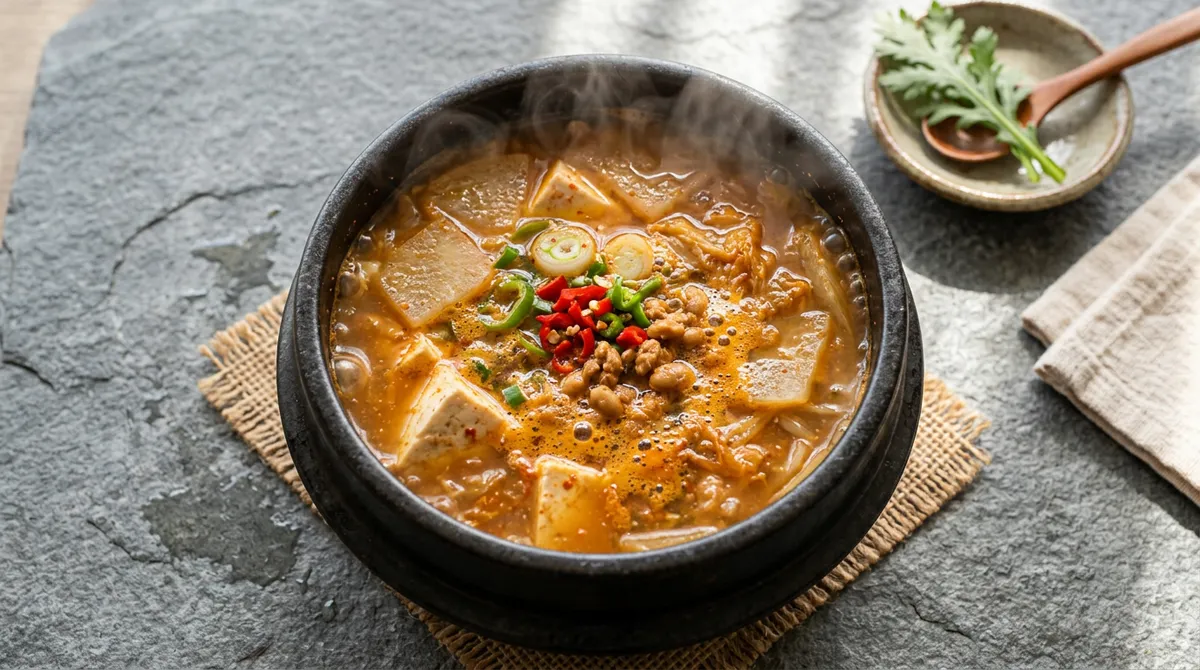 20 min
 15 min
 90 min
Dried Anchovy (for stock)
The inosinate side of the classic Korean stock base. Remove heads and entrails and dry-toast briefly to cut fishiness; pair with kelp for umami synergy.Dried Kelp (Dashima/Kombu)
Glutamate-rich; the partner that multiplies anchovy or bonito umami. The white surface powder is umami — don't wipe it off; steep rather than hard-boil.Frequently Asked Questions
- Why shouldn't I boil kelp?
- Hard-boiling kelp dissolves alginic acid and other viscous substances, making the stock slimy with off-flavors. A 30+ minute cold soak, or removing it just before boiling (~60-70°C), extracts maximum glutamate with minimum off-notes.
- Why remove anchovy heads and entrails?
- The entrails (gallbladder) contribute bitterness, and the heads concentrate off-flavors. Removing them and dry-toasting briefly cuts fishiness and adds a toasty note. Most corpus recipes include this prep step.
- How does the 7-8x umami synergy work exactly?
- When glutamate (from kelp) and inosinate (from anchovy/bonito) co-bind the umami taste receptor (T1R1/T1R3), the receptor conformation stabilizes, producing ~7-8x stronger umami signaling than either compound alone. Discovered by Kuninaka, this synergy is exploited in Korean, Japanese, and Western cooking alike.
- Can vegetable stock deliver enough umami?
- Absolutely. Glutamate from kelp and guanylate from dried shiitake create nucleotide synergy. Add the natural sweetness of radish and onion, and you get a deep broth without any animal ingredients. Several corpus recipes confirm this approach.
How to Make Basic Anchovy-Kelp Stock
- Remove heads and entrails from dried anchovies (~30g), then dry-toast in a pan over medium heat for 1-2 minutes to cut fishiness.
- Wipe kelp (~10g) lightly with a damp cloth to remove dust only — do not wipe off the white powder (that's umami).
- Add 6 cups (~1.2L) water and kelp to a pot. Cold-soak for at least 30 minutes. (If short on time, skip straight to the next step.)
- Heat over medium. Just before the water boils (small bubbles at the edge), remove the kelp.
- Add the toasted anchovies and simmer over medium heat for 10-15 minutes. Remove anchovies and the stock is ready.